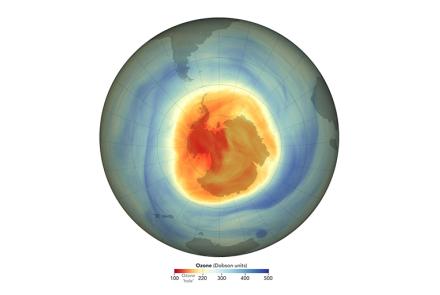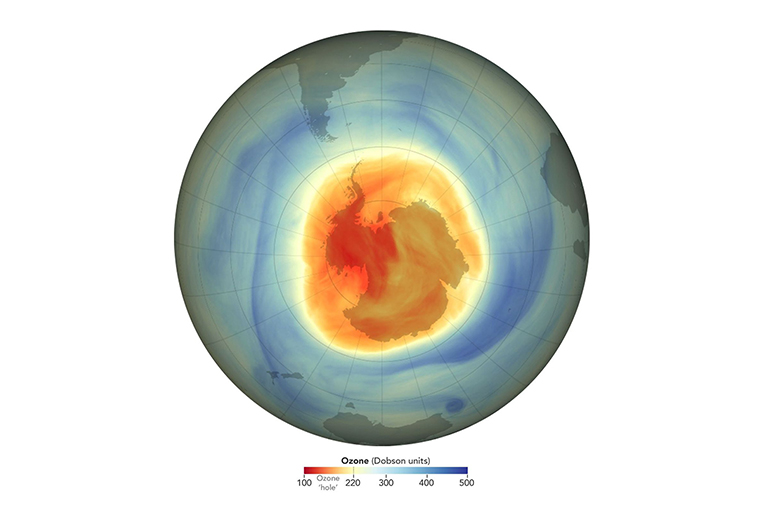
Although the Antarctic ozone hole in 2026 was one of the ten largest recorded since scientists began monitoring it nearly five decades ago, scientists attribute its unusually large size mainly to a strong and persistent polar vortex, a ring of cold winds around Antarctica that created ideal conditions for ozone depletion.
At its peak between 7 September through to 31 October, the hole covered an average area of about 9.6 million square miles (25 million square kilometres), more than twice the size of the United States, making it the seventh largest recorded since satellite monitoring began in 1979.
While the ozone hole was large in terms of area, it was not as severe as some of the record-breaking ozone holes observed in the past, with measurements showing that ozone concentrations remained higher than during the most depleted years of the early 2000s. suggesting that overall ozone layer recovery remains on track.
If this is a bit confusing it helps to understand how ozone depletion works. When chlorine- and bromine-containing chemicals released into the atmosphere from human activities reach the Antarctic stratosphere, these compounds are broken down by sunlight, releasing atoms that destroy ozone molecules. The process is amplified by polar stratospheric clouds that form in extremely cold conditions. The polar vortex, a ring of strong winds that encircles Antarctica each winter and spring, traps this cold air and creates the conditions that allow ozone depletion to occur. This year, the vortex remained unusually strong and extensive because atmospheric wave activity that normally disrupts it was weaker than usual. This allowed ozone-depleting conditions to persist over a larger area for longer than in many recent years.
“The annual ozone hole has been forming later and breaking up earlier in recent years, which tells us the ozone layer is healing,” said Paul Newman, a senior scientist at the University of Maryland-Baltimore and longtime leader of NASA’s ozone research team at the agency’s Goddard Space Flight Center in Greenbelt, Maryland. “But an unusually powerful polar vortex has extended ozone depletion in the Antarctic this season, allowing the hole to grow to proportions we haven’t seen in a decade.”
While these unusual weather conditions contributed to a large ozone hole this year, the broader story remains one of recovery. Decades of action under the Montreal Protocol have reduced concentrations of ozone-depleting substances in the atmosphere and set the ozone layer on a path to healing. Scientists emphasise that the 2026 hole would likely have been larger had ozone-depleting substances remained at ore-industrial levels, underscoring both the continued influence of natural variability and the lasting impact of one of the world's most successful environmental agreements.
…../
Full NASA 2026 ozone report available here.
View the latest status of the ozone layer over the Antarctic with NASA’s ozone watch.
For more information contact: Stephanie Haysmith, Communications & Public Information, Montreal Protocol Ozone Secretariat (stephanie.haysmith@un.org)