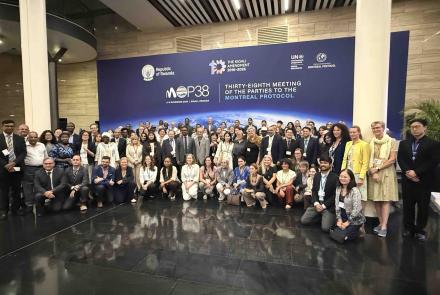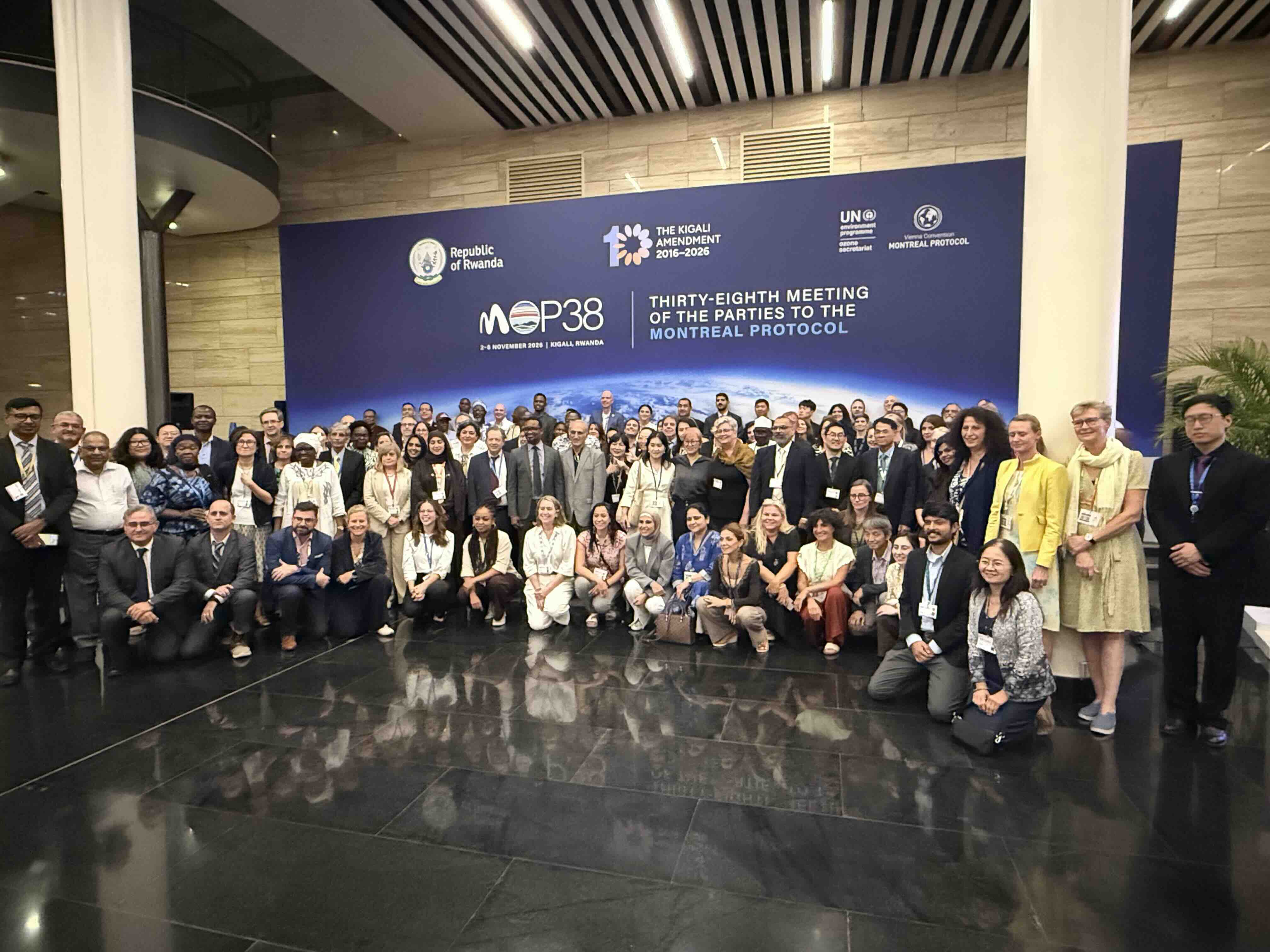
The Thirty-Eighth Meeting of the Parties to the Montreal Protocol (MOP38) took place in Kigali, from 2 to 7 November 2026, hosted by the Government of Rwanda. The meeting also marked the tenth anniversary of the adoption of the Kigali Amendment bringing back the parties and other ozone stakeholders to the same venue where this landmark agreement to reduce hydrofluorocarbons (HFCs) was adopted.
A critical outcome of MOP38 was agreement on the 2027–2029 replenishment of the Multilateral Fund (MLF), the financial mechanism under the Montreal Protocol that supports Article 5 parties in implementing their Protocol obligations. Following intensive negotiations that extended into the early hours of Saturday morning, parties agreed on a replenishment package of US$695 million, consisting of $360 million in new contributions and $335 million in carryover funding.
The final replenishment package ensures continued and adequate support for HCFC phaseout and HFC phasedown activities and addresses the efficient use of unspent funds held by the MLF.
Another major issue considered at MOP38 is the current levels of HFC-23 emissions, specifically the gap between reported and observed levels of HFC-23 in the atmosphere as presented in the update from the TEAP and the Scientific Assessment Panel (SAP). HFC-23 is among the most potent greenhouse gases controlled under the Montreal Protocol and contributes disproportionately to climate warming relative to its volume. Parties considered the continuing discrepancy in bottom-up and top-down emissions data and adopted a decision encouraging voluntary sharing of observationally derived emissions data and any related analysis concerning HFC-23 generation and emissions and requesting additional scientific analysis and reporting by the SAP as part of efforts to improve understanding of remaining inconsistencies.
MOP38 also approved steam plasma arc as a destruction technology for concentrated sources of CFCs, HCFCs and HFCs.
Parties also continued discussions on enhancing regional atmospheric monitoring of controlled substances. The Ozone Secretariat and the Advisory Committee of the General Trust Fund for Financing Activities on Research and Systematic Observations Relevant to the Vienna Convention updated the parties on efforts to address gaps in the global monitoring network. Deliberations focused on the establishment of additional monitoring stations in underrepresented regions, particularly in the Global South, and on governance, financing, data-sharing and liability arrangements. Despite an acknowledgement of the importance of these issues, parties could not agree on matters such as operational arrangements for potential host countries. Thus, no decision on this matter was adopted by MOP38.
Building on discussions initiated at previous meetings, MOP38 considered proposals on strengthening Montreal Protocol institutions and facilitating implementation. Negotiations focused on improving licensing systems, data reporting, information exchange and measures to combat illegal trade in controlled substances. A final agreement could not be reached on a decision, including on any additional tools for use parties on a voluntary basis. Further consideration of the matter will continue next year.
Discussions on the viability of Montreal Protocol operations continued, with measures for maintaining the effectiveness of the Protocol while making more efficient use of resources being explored. Parties agreed, among others, on a trial reduction in 2027 of the duration of the Open-ended Working Group meeting from five days to four days, an online presentation by the TEAP of its progress report, use of software-based tools for the translation of meeting documents, and the conduct of meetings of the MOP38 Bureau in English only.
Parties also adopted decisions relating to the organisation of the TEAP and its Technical Options Committees including restructuring the TEAP’s Medical and Chemicals Technical Options Committee, limiting the reporting requirements of the Methyl Bromide Technical Options Committee and the Rigid and Flexible Foams Technical Options Committee to every two years, subject to specific needs of the parties to the Montreal Protocol, and reducing the frequency of some in-person technical meetings.
A total of 22 decisions were adopted at MOP38 including the annual budget for Ozone Secretariat operations for 2027.
The 10th anniversary of the Kigali Amendment featured prominently throughout the meeting. The Executive Secretary of the Montreal Protocol Ozone Secretariat Meg Seki noted her opening address the Protocol’s extraordinary record of achievements. Phasing out 99.5 per cent of ozone-depleting substances to date has helped ensure ozone layer protection and recovery, while through the Kigali Amendment and energy efficiency on cooling, we can avoid up to one degree Centigrade of global warming by the end of this century. The milestone achievements were also echoed by the Elizabeth Maruma Mrema, Deputy Executive Director of the United Nations Environment Programme (UNEP) in her speech to delegates at the opening of the high-level segment, as well as by parties, ministers and senior officials throughout the week.
High-level segment
The high-level segment of MOP38 was opened by Paul Krajnik of Austria, President of the Thirty-Seventh Meeting of the Parties, highlighting the work that had been carried out by the parties over the past year, after which he handed over the presidency to the newly elected MOP38 president Bernadette Arakwiye of Rwanda. Following the address of Elizabeth Maruma Mrema of UNEP, Justin Nsengiyumva, Prime Minister of Rwanda took to the lectern to reflect on the achievements under the Montreal Protocol and the Kigali Amendment.
A high-level roundtable marking the Kigali Amendment’s anniversary highlighted national experiences with HFC phase-down and sustainable cooling followed the opening speeches. Panelists emphasised the importance of stakeholder collaboration, technology transfer, financing and workforce development. Several countries shared practical examples of implementation, including refrigerant recovery and recycling centres, technician certification schemes, national HFC quota systems and initiatives promoting energy-efficient cooling technologies. Participants stressed that future Kigali Amendment implementation must increasingly focus on integrating cooling access, energy efficiency and climate objectives.
The high-level segment also heard updates from the Protocol's Environmental Effects Assessment Panel (EEAP), TEAP and SAP which highlighted both continuing progress and emerging environmental challenges.
Statements made later by ministers and other high-ranking representatives emphasised growing global cooling demand, the importance of energy efficiency alongside refrigerant transition, increasing attention to life-cycle refrigerant management and the need for continued scientific monitoring and assessment. Speakers repeatedly stressed that access to sustainable cooling is becoming increasingly important for food security, healthcare, economic development and climate resilience, particularly in developing countries and regions experiencing extreme heat.
On compliance matters discussed prior to MOP38 by the Implementation Committee, parties adopted eight decisions recommended by the Committee concerning reporting, licensing, HFC baseline adjustments, and compliance issues under the Protocol. The parties also adopted a decision on Azerbaijan enabling it to include a 25 per cent HCFC component in its HFC baseline and apply HFC control measure similar to those used by five other non-Article 5 parties.
The participation of the Central Asian States within the Eastern European States group, which remains unresolved, impacted the discussions on regional group representation, ultimately affecting nominations to several Montreal Protocol bodies. Although parties agreed on the Eastern European seats on the MOP38 Bureau and the Executive Committee of the Multilateral Fund, they were unable to fill one Eastern European Group seat on the Implementation Committee.
On the sidelines, there were numerous side events and exhibition booths, as well as a special film screening of ‘The Path to the Kigali Amendment’ and a reception to celebrate the 10th anniversary of the Kigali Amendment. Prior to the screening, Paul Taylor, head of the Australia delegation informed the parties and other ozone stakeholders on the inaugural Paul McInerney Award for 2027.
In closing the meeting, the Executive Secretary paid a special tribute to outgoing members of the Montreal Protocol family including Annie Gabriel (Australia), Yaqoub Almatouq (Kuwait), Jim Curlin (OzonAction) and Thanavat Junchaya (World Bank). The delegate of Japan, in turn, noting MOP38 would be the last with Meg Seki at the helm, applauded her long service and her excellent stewardship of the Secretariat.
For more information contact: Stephanie Haysmith, Communications & Public Information, Montreal Protocol Ozone Secretariat (stephanie.haysmith@un.org)